Featured

Legal Analysis: NDIS Proof-of-Diagnosis Reforms Diminish Legal Access for Participants

The team at D-Stress Solutions, our sister company, are diving into the latest NDIS General Issues report to find what participants and health organisations need to know in the second half of 2021.

Main points:

  • Clear Liability for the quality of Independent Assessments and subsequent receipt of services left stranded between a triangle of entities.
  • Independent Assessors will also be robbed of their right to legal indemnity protections by their employer.
  • The Independent Assessment process is going to be a one-size-fits-all-script that the government will give assessors to read off of, removing the need for professional competency requirements.
  • Personal Doctors, GPs, Psychiatrists, and other medical specialists, will be removed from the Assessment Process altogether.
  • This means they are less likely to be able to attend court as witnesses if there is a dispute.
  • The changes appear deliberately designed to disadvantage the legitimacy of claims for support based on psychosocial grounds.

A legal analysis by the team here at D-Stress Solutions, surveying publicly available information published by the NDIS, reveals upcoming changes to Australia’s Disability welfare scheme will categorically make it harder for Participants to prove damages in a Court of Law, where related to the quality and receipt of any disability services received.

In what information has been published by the NDIS so far regarding changes to the Independent Assessment process; all clear indication of ultimate liability protecting Australian participants is strategically left suspended in a grey area between Services Australia; the NDIA, and, commercial entities recognised as Independent Assessment providers.

By seeking to remove the requirement for official diagnosis paperwork to be witnessed during initial and repeat consultations, proponents of the NDIS are functionally removing the involvement of personal GPs and Doctors from the assessment process, as well as any other medical professionals — also making those documents less likely to be used as evidence in disputes, and hampering the ability of GPs to act as witnesses in court.

We interpret this will particularly limit the legal rights of participants presenting with psychosocial considerations, who often depend wholly and completely on diagnosis paperwork to provide legitimacy of a claim.

Too Many Cooks

We interpret also that this dilution of Liability across multiple bodies means any Participant who suffers harm by way of inappropriate decisions, made during any stage of the assessment or delivery process, is far less able to straightforwardly sustain a claim against any of the aforementioned bodies; or combination thereof.

Based on information published by the NDIS, we additionally flag our interpretation that from July, Services Australia will not be liable for the decisions of the NDIA; similarly, the NDIA will not be liable for the appropriate delivery of services (nor for acting or failing to act as directed by Services Australia,) and finally, Independent Assessors will not be held to any professional competency guarantees offered by medical or health training, where related to the wellness outcomes of the participating consumer.

We interpret these changes are deliberately designed to minimise the efficacy of negligence and unconscionable conduct claims, made against the NDIS, from 2022 onwards.

Tipped to Start in July, Maybe

According to what information is publicly available regarding the upcoming Independent Assessment changes to the NDIS, the new measures will begin to roll out from July 2021.

Taking Doctors out of the Process

The removal of diagnosis paperwork from the Independent Assessment process greatly diminishes the ability of Participants to rely on their own personal Doctors as secondary advocates, and the eligibility of those same Doctors to participate in Court matters involving their patient(s).

The Government’s decision to design a standardised questionnaire, to be used in every participating Assessor’s office across Australia, can easily be described in another way: the Government is simply handing Assessors scripts to read off of.

We interpret this will also diminish the ability of the Assessor to act autonomously at all, as well as infringing on their rights to access indemnity protections.

These changes also ensure that 3rd parties take on the labour of ensuring consistency across government communications, as currently seen in the requirements placed upon APM in the DES program.

Proposed Reforms Simply Spin

Simply, we don’t know yet what will stand in Court — however, it’s clear that executive and high-level proponents of the NDIS are greatly invested in minimising their exposure to risk.

This in itself does not consist of any illegality, but does further ratify the sense of uncertainty the Disability community currently feels ahead of July, Australia-wide.

By: D-Stress Solutions Managing Facilitator Jonathon Davidson
Featured

We Weren’t Prepared. One Year Later, We Still Aren’t — NDIS And Covid-19

The team at D-Stress Solutions, our sister company, are diving into the latest NDIS General Issues report to find what participants and health organisations need to know in the second half of 2021.

The NDIA should review existing NDIS Covid response mechanisms, and publish pandemic plans for the future.

This is the top recommendation in the latest NDIS General Issues report by the Joint Standing Committee on the National Disability Insurance Scheme from December.

Right now, two things are clear: everybody, in every sector, is doing their best — but people are still falling through the cracks. 

Now, Australians living with disability face refreshed stressors, as tenancy security is impacted by a nation-wide trend of rising rent prices; and, upcoming eligibility changes to the NDIS continue to impose great clouds of uncertainty over participants’ capacity to appropriately future-plan. 

Western Australia is currently recording a high number of eviction letters being sent to residents, and, numerous community organisations and advice lines alike are reporting high receipts of calls pertaining to eviction matters.

This trend is continuing everywhere, regardless of participation status under the NDIS — but NDIS participants are far less likely to sufficiently support themselves through negotiation, dispute, and administrative procedures.

D-Stress Solutions can also reveal from first hand experience a number of local WA shelter facilities — often relied upon by tenants of diverse backgrounds experiencing conflations of homelessness and disability — are currently being forced to evict tenants. 

D-Stress Solutions Managing Facilitator Jonathon Davidson says the Western Australian government is damaging its own economic recovery.

“By failing to redirect homeless Australians into more productive circumstances, let alone those with disability, we are just guaranteeing future costs down the line in rehoming and re-engagement,” Mr. Davidson said. 

“It makes no economic sense. We know full well securing accommodation for those struggling now, and making that upfront cost now, leads to greater returns for everyone, and the community, in less than a decade.”

“We shouldn’t be afraid to say this out loud, over, and over, and over again: it makes no economic sense.”

Perhaps this is why, in December 2020, when the General Issues report was published, recommendations 7 & 8 of the document pertain specifically to NDIS engagement with Homeless Australians, and, Homeless Australians with an eligible disability, currently not covered under the NDIS. 

In difficult quarantine circumstances, coupled with a period of high mistrust and anxiety — unfortunately, by all parties — many liaison projects designed to do this are failing to satisfy desired outcomes.

In many parts of WA, those projects simply never hit the ground, leaving question marks lingering over annual spending responsibilities. 

What is happening in the small end of town can also be traced back up to the top end of town, too — tens of thousands of Australian businesses have gone under this year alone, and Insolvency applications have been streamlined by Australia’s corporate regulator to handle the sheer demand of workflow facing those departments over the coming twenty four months. 

Within the NDIS, too, a similar high-intensity workload is guaranteed to flow through state and federal departments for at least the next twenty four months to come. 

If you, or somebody you represent, are experiencing difficulties right now with the NDIS plan, you are not alone. 

For any NDIS concern, and any similar concerns such as rental or accommodation matters, you can contact D-Stress Solutions for cheap advisory information costing only $75 per hour. 

Call: 0410 537 245 
Email: dstresswa@gmail.com 
Or, find us on Facebook

5 NDIS Questions We Have About the 2021-22 Budget

The team at D-Stress Solutions, our sister company, are diving into the latest NDIS General Issues report to find what participants and health organisations need to know in the second half of 2021. This time, we’ve gone into the Budget.

May be an image of text that says "The Budget also includes further measures that focus on disadvantaged job seekers and those most impacted by the pandemic. The Government will introduce a new employment services program to replace jobactive from 1 July 2022. The new program will enable job-ready job seekers to self-manage their job search on a digital platform and redirect resources to intensive face-to-face services for the most disadvantaged job seekers. Job seekers in Disability Employment Services will also be able to participate in digital services to find employment from January 2022."
Budget Paper #1 – Page 24

Will Disability Employment Services (DES) Participants Be Able to Opt-Out of Digital Services From Jan 2022?

Page 24 of Budget Paper 1 contains a reference to upcoming changes in the structure of the existing Disability Employment Services (DES.)

According to NDIS information, APM are one company who will overtake the Independent Assessment process, and who also currently offer JobSeeker and DES Services.

Will Australians with a Disability, who are deemed “non-severe,” still be able to choose face-to-face meetings if they want?

May be an image of text that says "A significant portion of government expenditure is for demand-driven programs. Outcomes for these programs could differ from the estimates and projections due to changes in economic circumstances and other factors. For example, differing levels of unemployment will mean expenditure for related social services payments, including allowances, will continue to vary. Similarly, a number of other support programs, including the National Disability Insurance Scheme, are demand-driven and outcomes for these programs may differ from the estimates in the Budget."
Budget Paper #1 – Page 257

Will The NDIS Be “Fully Funded” At A Fixed Cost, or Based on Up-And-Down Demand?

While the Treasurer told the Chamber that the NDIS will always be “fully funded” by the Coalition, a clause on page 257 of the first paper reveals commitments to costs are not fixed.

I interpret this to mean that where demand will fluctuate over the coming years – in other words, go up and down – so will the amount of government support varying projects will actually receive.

What does this mean for the NDIS during the aftermath of an ongoing international health crisis?

May be an image of text that says "$860.4 million over four years from 2021-22 by transitioning from jobactive to NESM rom 1 July 2022, which provides more efficient services through enabling job seekers to choose digital support services rather than face to face services, if they are eligible. Job seekers in Disability Employment Services will also have the option of digital services from 1 January 2022, initially through Online Employment Services and NESM from 1 July 2022"
Budget Paper #2 – Page 105

Why Are Disability Payment Recipients Being Pushed Into An Experimental Overhaul of The Jobactive System First?

Language used on page 105 of Budget Paper 2 seems to suggest that JobActive will transition to a system called NESM next year.

I interpret the language to mean mainstream welfare services will also be amalgamated into the changes.

Does this mean that persons on the DES will be used as the test case for the overhaul of service delivery, to something called the NESM?

May be an image of text that says "$112.4 million over four years from 2021-22 for continuity of psychosocial support services for people with a severe psychosocial disability who are not eligible for the National Disability Insurance Scheme"
Budget Paper #2 – Page 105

Does The Fund for ‘Psychosocial’ Support Suggest NDIS Diagnosis Assessments Will De-Prioritise Mental Disability?

On page 105 of Budget Paper 2, there is mention of AUD$112M to support Psychosocial services.

According to our Legal Analysis published earlier this week, upcoming Independent Assessment changes to the NDIS will categorically make it harder for Australians with a non-physical and non-brain Disability to legitimise a claim for support.

No photo description available.
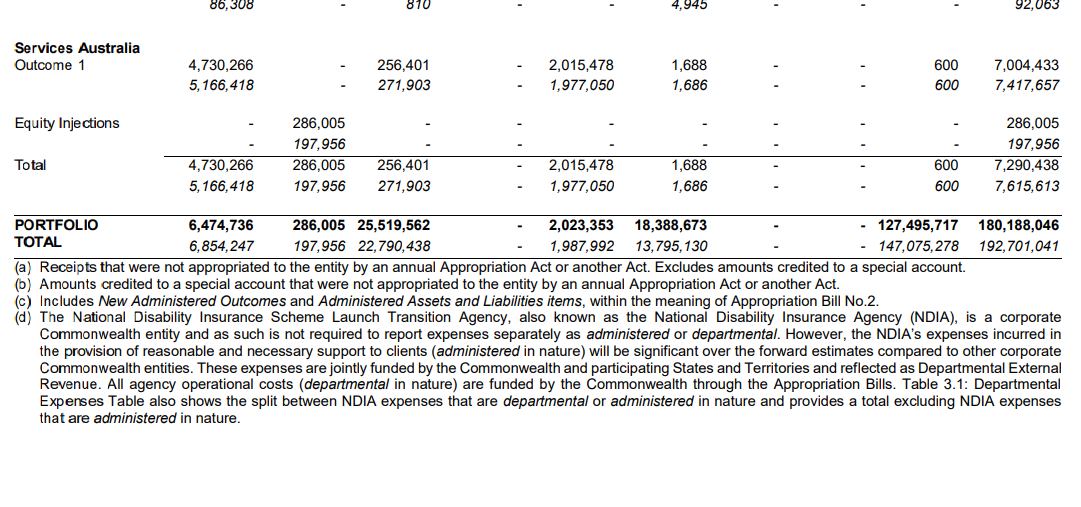
Page #4 – Page 112

Will Australians Be Able to Meaningfully Unpick NDIS Non-Departmental Cost Expenditure?

On page 112 of Budget Paper 4, beneath a table of expenditure costs, there are several methodological notes.

The fourth note, note (d), reveals “Non-Departmental” costs will be labelled as ‘External Revenue.’

I interpret this language is intended to strategically award NDIA proponents significant wiggle room in the public reporting of actual costs spend by the NDIS in the service delivery arms.

I interpret the language of footnote (d) to imply that actual service delivery costs will be labelled as ‘Administered Costs,’ instead of ‘Departmental Costs,’ for which reporting requirements are far more relaxed.

And will this affect the level of perceived demand?

By: Jonathon W. Davidson, Managing Facilitator at D-Stress Solutions.

Impact of Covid-19 on WA Chronic Hoarders Unknown

As WA faces a rise in calls to shelters and tenancy services, there is one cohort of West Australians who are completely unaccounted for in Health and Housing data — people living with Chronic Hoarding habits.

In fact, there has been no major WA, or Federal review, of Health policy for Chronic Hoarding in the last seven years — let alone since the start of Covid.

D-Clutter Bugs Managing Consultant Ms. Lea Davidson says the current landscape is causing huge amounts of concern.

“The one common thing I am seeing and hearing from people lately is that there is absolutely no certainty surrounding anything,” Ms. Davidson said.

“If you consider the number of eviction notices being received right now, we’re basically throwing some of the most vulnerable people into the deepest end of the pool, without even a flyer.”

This lack of certainty is an unnecessary burden, and not only for those living with Chronic Hoarding habits during a Lockdown who may be facing eviction or intervention orders.

This same lack of certainty – and complete lack of data – also hinders the ability of health organisations and real estate agents to cooperate or otherwise harmonise their efforts in providing ongoing supports.

“We hear a lot of talk about inter-agency Collaboration, but right now, there’s nothing to realistically collaborate on at all,” Ms. Davidson said.

The last time WA launched a major attempt to address the prevalence of Chronic Hoarding in WA was in 2013 — and only as part of a nation-wide strategy.

Practitioners in WA currently rely on a Local Government toolkit from 2013.

D-Clutter Bugs provide De-Cluttering and Home Organising & Cleaning services in the WA Metropolitan area.

D-Clutter Bugs Managing Consultant Lea Davidson is a lifetime Member of the Port School Association for youth at risk of disengaging with education; and has worked for over fifteen years in the cleaning and domestic support sectors.

Media Contact — Mr. Jonathon Davidson | 0410537245